

By Chris Umpierre
MIAMI REALTORS® + RWorld
MIAMI — The sounds of “Oye Cómo Va” fill the historic Freedom Tower’s Grand Hall, a space that has witnessed devastation, sorrow, and hope.
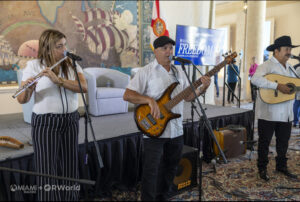
A three-member, guayabera-clad band are playing beneath the building’s 46-foot Spanish-inspired vaulted ceiling. Guitar and güiro set the rhythm as an impromptu salsa dance breaks out. Around the room are croquetas con jamón, Frita Cubana, flan and, of course, ubiquitous white Cuban Cafecito cups.
More than half a century after the Freedom Tower served as a processing and assistance center for 400,000 Cuban refugees arriving in the United States, its history was woven into a celebration of the immigrants who helped transform Miami into a global city.
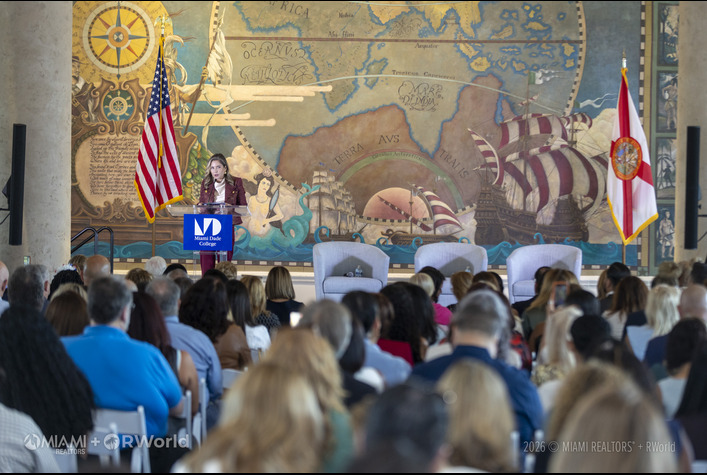
That past — and the future it helped create — was on full display Tuesday, Sept. 22, at Built on Freedom: Miami City Spotlight, a sold-out event hosted by MIAMI REALTORS® + RWorld and Miami Dade College. More than 200 MIAMI + RWorld members gathered for the event at the 101-year-old Freedom Tower, which served as a processing center from 1962 to 1974 and is known to many Cuban exiles as El Refugio, for a conversation about Miami’s immigration story and the people who helped shape its rise as a global destination.
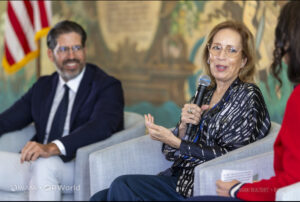
David Martin, CEO of Terra, and Alicia Cervera Lamadrid, managing partner of Cervera Real Estate, headlined the event. Both are Cuban Americans whose parents left Cuba with little and went on to build influential Miami real estate businesses.
Martin’s connection to the Freedom Tower is particularly personal. In 2004, Pedro Martin, David Martin’s father, purchased the historic building from the Mas family. The Martin family then donated it to Miami Dade College in 2005. After a multi-year, $25 million restoration, Miami Dade College opened Freedom Tower’s new “Libertad” exhibition in 2025. It is one of four major exhibitions at the restored Freedom Tower, spanning the first and second floors.
“When your family took control of the Freedom Tower and essentially gave it back to the people, it was such a full circle moment,” Cervera told Martin. “It was such a moment of pride. How many immigrant communities can say we arrived in total destitution and with the tragedy of communism and then to come to this incredible and generous country and this magic city to this beautiful building that was filled with such sorrow and devastation.
“(David) it was absolutely the best tribute you could give us. In taking control of this building through sweat, work, ingenuity and creativity and putting it in the magical hands of our city and the under the guidance of Miami Dade College. I want to thank you publicly. It’s a monument to what can be done by the immigrant community.”
Symbol of Hope, Freedom, and the Cuban American Experience
Built in 1925, the Freedom Tower was commissioned by James M. Cox, the former governor of Ohio and owner of the Miami Daily News, as the newspaper’s headquarters and printing plant. At 255 feet and 17 stories, it was one of Miami’s tallest buildings when it opened. Designed by New York firm Schultze and Weaver, the building reflects Spanish and Italian architecture, with Moorish touches, and was inspired in part by the Giralda tower at Seville Cathedral. The Miami Daily News moved into the building when it opened on July 26, 1925.
After Fidel Castro came to power in Cuba in 1959, his ruthless Communist government nationalized businesses and property, prompting hundreds of thousands of Cubans to leave the island. Many came to Miami.
In 1962, the U.S. government leased the former Miami News Tower and opened the Cuban Assistance Center there. For the Cuban refugees who passed through its doors, the building became known as “El Refugio,” or “the refuge.” The center provided medical care, food, financial assistance, housing and other services as newly arrived Cubans began building lives in the United States. It remained a center for Cuban refugee assistance until 1974.
“Spain gave the Freedom Tower its architecture but it’s the Cubans who came through here who gave the Freedom Tower its soul,” Miami Dade College President Madeline Pumariega said.
A self-described “girl from Hialeah” whose own parents came through the Freedom Tower, Pumariega now leads the nation’s largest college with 58,941 students.
“Where we’re sitting in this beautiful Grand Ballroom, it had checkered black-and-white floors,” Pumariega said. “The walls were green, and the light was yellow. There were small areas partitioned off. You came in, you received information, you were processed here and then sent all over the country.”
MIAMI REALTORS® + RWorld Residential President Dinorah Guerra, a Cuban-American born and raised in Miami, emphasized the power of the Freedom Tower.
“This building represents so much about what makes Miami special,” Guerra said.
RPAC Major Investors Tour New Freedom Tower Libertad Exhibit
MIAMI REALTORS® + RWorld RPAC Major Investors received a special pre-event tour of the Freedom Tower, showcasing its newly curated exhibits and highlighting the building’s powerful history as a symbol of hope, freedom, and the Cuban American experience.
The exhibit is titled “Libertad” or Freedom. It begins on the second floor of the Freedom Tower with a video in a theater. Then it transitions upstairs to the skyline gallery where there are 700+ oral stories of Cuban coming to America with just a suitcase filled with grit, resilience and gratitude.
The exhibit pays respects to Pedro Pan, the U.S.-backed program from 1960 to 1962 that sent over 14,000 unaccompanied Cuban children—mostly 4 to 18—from Cuba to the United States, primarily to Miami.
Many in attendance had family members go through the Freedom Tower processing. MIAMI REALTORS® + RWorld Chairman of the Board Alfredo Pujol’s mother came through the Freedom Tower in 1967 when she was 14 years old.
MIAMI REALTORS® + RWorld Residential Board Governor Jeannette Pressman brought her mother, Maria, who came from Cuba to the U.S. through the Pedro Pan program. Just 11 years old, she spent one year without her family in Miami.
“Se emociona” or one gets emotional, Maria said.
100 Years in 10 Minutes Miami Presentation
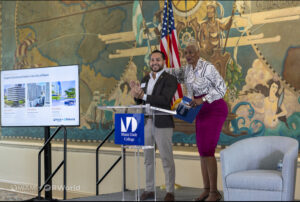
2027 MIAMI REALTORS® + RWorld Residential President Ruben Sanchez and President-Elect Angelique Hibbert presented on Miami’s history over the last century and market statistics.
From swamp to third-tallest U.S. skyline: that’s Miami’s story.
“In 1925, the Freedom Tower was built at 255 feet, and it was Miami’s tallest building,” Sanchez said. “It’s amazing because now we are having a tower built over 1,000 feet high.”
MIAMI REALTORS® + RWorld Chief of Residential & Engagement Claudia Bailly, who worked with Guerra on months to put together the event, celebrated MIAMI REALTORS® + RWorld Co-CEO Teresa King Kinney, who will be retiring from her iconic 33-year real estate career at year-end.
“I used to say Miami is so welcoming they even accepted us from Missouri,” Kinney said. “The reality is that the Miami you and your families built is what the world wants to come to.”
Moderating the keynote panel between Martin and Cervera, Florida Senator and MIAMI REALTORS® + RWorld Chief of Strategic Initiatives Ana Maria Rodriguez asked the powerhouse real estate brokers about Miami’s future.
“I see a much stronger international market over the next 5-10 years,” Martin said. “I see demand continuing to come domestically as people realize what a great place this is to live.”
More than half of Miami’s residents are foreign-born. There are hundreds of languages spoken here. South Florida is the No. 1 U.S. destination for global homebuyers.
“Miami is organically what the rest of the world is trying to be,” Cervera said. “We don’t have to legislate or litigate or rules or regulations because in this city we accept people from all over the world. We don’t care what color you are. We don’t care what religion you are. We don’t care what you do. The only thing we care is if you come here to add. Whether you’re adding a smile or Citadel and all kinds of jobs.”
-30-
